Exactly How to Optimize Follower Curves for Better CPU Temps and Lower Noise
The Ugly Reality: A Lot Of Follower Contours Are Panic Curves
Followers exist.
I have seen pricey builds with 360 mm AIOs, 10 instance followers, "quiet mode" tags, and motherboard software program that still acts like a terrified intern each time the CPU package temperature level jumps from 48 ° C to 68 ° C for three seconds during a browser launch. Why are we still calling that optimization?
CPU follower contour optimization is not regarding making every fan spin slower. It is about making a decision when the system must respond, just how fast it needs to react, and which sensor should have authority. That last part issues. A CPU can surge hard for a minute, specifically modern boost-heavy chips, while the cooler mass, radiator, situation air, and human ear experience the occasion far more slowly.
Right here is my unpopular opinion: most default motherboard follower curves are contacted shield the supplier from assistance tickets, not to provide you the very best sound account. They ramp early. They ramp dramatically. They presume the customer will condemn the board if the CPU gets hot, yet will certainly endure a loud follower if the temperature level number looks reduced.
That profession is lazy.
Intel states cpu optimum joint temperature differs by product and is generally in between 100 ° C and 110 ° C, with thermal controls decreasing regularity and power when limitations are approached. Check out Intel's processor temperature support prior to dealing with 80 ° C like a smoke alarm. AMD's Ryzen 9 7950X, as an example, provides a 95 ° C max operating temperature level on AMD's official product web page. Hot is not instantly hazardous. Unrestrained is the trouble.
And sound is not cosmetic. The CDC's NIOSH advice establishes a recommended work-related direct exposure limit of 85 dBA over an eight-hour shift, and while your computer should not be anywhere near that at your workdesk, the factor still holds: sound direct exposure is measurable, collective, and worth taking seriously. The NIOSH noise direct exposure web page is not gaming-PC web content, but it is a helpful pointer that "simply a little louder" is not constantly insignificant.
So yes, we tune.
What a Follower Curve Actually Controls
A follower curve informs your motherboard or controller how fast a fan ought to rotate at specific temperature level factors, generally by mapping temperature in ° C to follower rate as a portion or RPM target. A good follower curve protects against thermal throttling while staying clear of abrupt RPM jumps, tonal gripe, and unneeded sound throughout short CPU temperature level spikes.
Simple idea. Untidy execution.
The reason it gets messy is that CPU temperature level is twitchy. A Ryzen 7, Ryzen 9, Core i7, or Core i9 can jump 20 ° C in a short burst due to the fact that increase behavior is quick and silicon thermal mass is tiny. Your heatsink, radiator, or instance air does not transform that quickly. Your ear listens to the follower reaction, not the silicon event.
That is why I like combining this article with AceGeek's 3-pin vs 4-pin PWM fan overview. A 4-pin PWM follower provides better speed control than a basic voltage-controlled follower, and that issues when the goal is smooth CPU cooler follower rate instead of crude "slow or screaming" habits.
However hardware alone does not conserve you.
A great PWM fan with a bad contour is still poor. A premium CPU cooler in a restrictive case is still jeopardized. And a quiet preset that allows the CPU throttle under a genuine workload is not peaceful design; it is performance abandonment.
The Follower Contour Settings I In Fact Trust Fund
Beginning boring.
I would rather build a stable, conventional contour and afterwards unwind it than copy some discussion forum screenshot from a different CPU, cooler, instance, area temperature, biography version, and fan version. That is exactly how individuals end up chasing after ghosts.
Here is a sensible standard for CPU fan curve optimization:
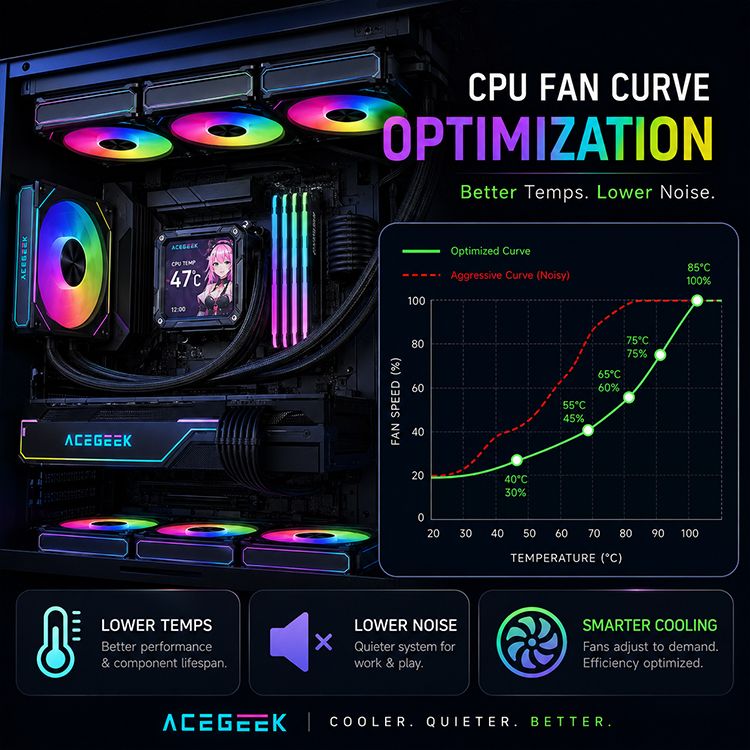
CPU TemperatureFollower Rate TargetWhat I'm Trying to Accomplish30 ° C-- 40 ° C 20%-- 30%Maintain idle and light desktop computer use quiet50 °C 35%-- 45%Take care of web browser, office, and launcher spikes without drama65 °C 50%-- 60%Begin significant cooling prior to continual lots works out in75 °C 70%-- 80%Control video gaming, providing, assembling, and hefty multitasking85 ° C+ 90%-- 100%Secure continual increase and avoid thermal strangling
Do not prayer this table.
Use it as a beginning map. If your cooler is a huge dual-tower air colder, you might have the ability to maintain the 65 ° C and 75 ° C steps lower. If your cooler is a tiny single-tower system, or your instance has inadequate consumption, you might need a steeper leading end. AceGeek's CPU cooler noise vs performance overview makes the same factor from one more angle: the very best outcome is not the most affordable temperature level or the lowest noise in isolation, yet the equilibrium your actual work can cope with.
Include Hysteresis or You Will Despise the Maker
Hysteresis is delay.
Without it, the follower curve reacts to every tiny CPU temperature jerk, and that is just how you obtain the maddening "whoosh, quit, whoosh, quit" pattern that makes a PC feel damaged also when temperatures are technically fine. That desires a device that seems nervous?
Set fan step-up delay around 3-- 5 secs and step-down hold-up around 8-- 15 secs if your BIOS or software enables it. I generally make spin-down slower than spin-up since fast cooling after a quick spike does not suggest the entire system has cooled down. The heatsink, radiator, VRM area, GPU exhaust, and situation air might still be warm.
This is where software issues. Biographies follower devices from ASUS Q-Fan, MSI Smart Follower, Gigabyte Smart Fan, ASRock FAN-Tastic Tuning, and energies like Fan Control can all work, yet the concept coincides: stop reacting quickly to meaningless spikes.
Make Use Of the Right Sensing Unit, Not the Loudest Sensor
CPU plan temperature level serves, but it can be also edgy for every single fan in case. For the CPU cooler fan, use CPU temperature level. For case consumption and exhaust followers, consider motherboard, chipset, GPU, or blended sensing unit reasoning where offered.
I recognize. That appears fussy.
But a front consumption follower that ramps just from CPU temperature level may overlook a warm graphics card dumping 300W to 450W right into the instance. A top exhaust follower tied only to CPU bundle spikes may holler throughout little desktop bursts. That is not air movement method. That is noise with a spread sheet.
For broader system air flow, AceGeek's write-up on why little cases fight with high-TDP hardware deserves connecting below due to the fact that tiny instances penalize careless assumptions faster. Limited quantity, brief airflow paths, and shared CPU/GPU heat lanes leave much less room for careless follower behavior.
My Screening Process Prior To I Touch the Contour
Measure initially. Guess later on.
I log idle temperature, video gaming temperature, maintained CPU lots, follower RPM, room temperature level, and sound impact prior to changing anything, due to the fact that "my CPU runs warm" is practically pointless without workload, ambient temperature, package power, and cooler behavior affixed. Are we diagnosing a thermal problem or simply reacting to a frightening number?
Utilize a repeatable process:
Allow the PC still for 10 minutes.
Document CPU temperature, follower RPM, and space temperature.
Run a regular workload: the real game, provide, compile, or application you appreciate.
Run a sustained cardiovascular test just after inspecting regular habits.
Adjustment one follower contour section at a time.
Re-test under the exact same problems.
Stop chasing after little gains when sound ends up being the larger charge.
For many customers, the best CPU follower curve setups are not severe. They are smooth. They maintain still low, delay response to spikes, ramp firmly under continual warmth, and get to full rate only near the factor where efficiency or silicon defense really matters.
That is the component the market maintains making also complicated.
AceGeek's cooler specifications short article fits normally right here since spec sheets alone do not forecast real thermal actions. CFM, TDP tags, radiator size, and dBA numbers all shed significance when the situation consumption is blocked, the follower contour is twitchy, or the CPU is enabled to pull much past its base power.
Air Cooler, AIO, and Instance Fans Need Various Curves
Different hardware is worthy of different follower habits. A tower air colder responds faster than a thick 360 mm radiator packed with coolant, while case followers ought to commonly respond to slower system warmth rather than every short CPU temperature spike. Treating all fans the same is one of the most convenient means to develop unnecessary noise.
Air coolers are straight. Warm relocations from CPU to IHS, thermal paste, chilly plate, warmth pipes, fins, and fan-driven air. The fan can react swiftly, yet too much rate change ends up being distinct fast.
AIO fluid coolers are slower in a beneficial method. The coolant loophole absorbs brief ruptureds, so the radiator followers do not require to panic immediately. I typically keep pump rate secure or on a gentle contour, then tune radiator fans with slower ramp habits.
Case fans are the forgotten center layer. They ought to feed the colder and get rid of heat, not cosplay as emergency alarms.
If visitors are still picking in between cooling types, AceGeek's air cooler vs liquid colder guide belongs in this write-up since fan curves can not remove the incorrect cooler option. A mid-range video gaming CPU in a breathable case may be happier with a strong air cooler. A high-wattage workstation CPU under lengthy all-core tons may warrant a 280 mm or 360 mm AIO.
And yes, thermal paste matters also. Yet not as high as people desire it to. AceGeek's thermal paste overview is the appropriate following action if temperature levels look unusually poor even after sane follower tuning, because a bad place or dried interface can make every fan contour appearance even worse than it is.
The Sound Math Nobody Wants to Place On package
Sound is not direct.
A follower jumping from 900 RPM to 1,500 RPM might look safe in software, however the acoustic character can change greatly, specifically if the follower crosses into a tonal whine array or starts battling grille restriction. This is why I do not rely on dBA claims without RPM, distance, test setup, and case context.
OSHA's sound web page sums up the NIOSH 3 dBA exchange-rate idea: every 3 dBA rise doubles audio power and fifty percents recommended exposure time under that design. See OSHA's occupational noise review. Your PC is not a factory floor, yet the math exposes the lie behind informal noise marketing.
A quieter PC typically originates from three relocations:
stay clear of sudden RPM jumps
keep fans below their aggravating vibration areas
enhance air flow so fans do not require strength
That last one is business end. If your front panel is restrictive, dirt filter blocked, radiator mounted terribly, or GPU warm trapped under the CPU colder, follower contour adjusting ends up being troubleshooting.
Not optimization. Damage control.
A Practical "Silent yet Safe" Follower Curve Dish
Right here is the fan curve I would certainly examine first on a regular video gaming or job PC with a modern-day PWM CPU cooler:
Follower Contour ZoneTemperature level RangeRecommended ActionsMy TakeQuiet idle30 ° C-- 45 ° C 25%-- 35% fan rate Keep the desktop computer calmnessSoft ramp45 ° C-- 60 ° C 35%-- 50% fan rate Avoid spike-chasingLots control60 ° C-- 75 ° C 50%-- 70% fan speed The majority of video gaming lands belowHefty lots75 ° C-- 85 ° C 70%-- 90% fan speed Safeguard boost clocksEmergency situation ceiling85 ° C+ 90%-- 100% follower speedSound serves below
After that include hold-ups.
Step-up: 3-- 5 seconds. Step-down: 10-- 15 secs. Minimum fan speed: whatever stays clear of clicking, delaying, or electric motor pulsing. Maximum follower rate: 100%, unless the last 10% adds unsightly sound with little temperature level gain.
I know some silence-first home builders cap followers at 70% or 80%. I obtain it. I additionally assume it is risky if the maker sees genuine warmth. A quiet cap is great just after evaluating worst-case tons, not in the past.
Typical Blunders That Make CPU Fans Louder
The initial error is establishing the contour too steep in between 50 ° C and 70 ° C. That array catches harmless increase spikes, so the fan maintains reacting to sound that the heatsink might soak up without dramatization.
The second blunder is utilizing zero hysteresis. Poor concept.
The third error is tuning idle and ignoring sustained load. A system that is peaceful on the desktop yet chaotic during pc gaming is not tuned; it is presented.
The fourth error is blaming the CPU cooler before inspecting the situation. A solid colder can not perform appropriately if it is taking a breath GPU exhaust or fighting a sealed glass front panel.
The 5th error is dealing with all CPUs the same. A 65W Ryzen 5, a 120W Intel Core i5 under turbo actions, a 170W Ryzen 9, and a 253W Intel Core i9-class workload do not be entitled to the same contours.
The 6th mistake is overlooking dust. Dust transforms filters into blankets. I wish that sounded more technological, however that is the entire point.
FAQs
What is CPU follower contour optimization?
CPU follower curve optimization is the process of mapping follower speed to CPU temperature so the cooler responds efficiently to genuine warm instead of short sensing unit spikes, keeping the cpu far from thermal strangling while decreasing abrupt RPM jumps, tonal noise, and unneeded fan wear throughout typical desktop, gaming, or work sessions.
In method, it means establishing sane temperature factors, using PWM control where feasible, including hysteresis, and screening under the workloads you really run. The goal is not the lowest possible CPU temperature. The goal is managed temperature with noise you can endure.
What are the very best CPU follower curve setups?
The best CPU follower curve settings typically maintain followers around 20%-- 35% at still, ramp gradually with 50 ° C-- 70 ° C, get to stronger cooling around 75 ° C-- 85 ° C, and book 90%-- 100% speed for sustained hefty loads or thermal-risk areas where efficiency loss ends up being more crucial than acoustic convenience.
For lots of pc gaming Computers, I would begin with 30% at 40 ° C, 45% at 55 ° C, 60% at 65 ° C, 75 %at 75 ° C, and 100%near 85 ° C. After that I would certainly readjust based upon CPU version, cooler size, situation air flow, ambient temperature, and follower noise personality.
Just how do I make my CPU follower more quiet?
You make your CPU follower quieter by flattening the low-temperature component of the follower contour, including step-up and step-down hold-up, preventing aggressive ramps throughout short CPU spikes, cleaning up filters, enhancing situation airflow, and validating the colder is mounted properly with a clean thermal interface.
Do not simply force a low maximum fan speed and call it repaired. That can conceal warm issues till the CPU strangles. A peaceful computer must still have a strong top contour for sustained load, even if it remains mild during still and light use.
Should CPU followers go for 100%?
CPU fans must run at 100% just near high-temperature or sustained-load conditions where thermal throttling, clock loss, or system instability comes to be more important than sound, due to the fact that full-speed procedure frequently includes a lot of acoustic annoyance while supplying only small temperature level renovation past a specific factor.
I do not mind 100% as an emergency ceiling. I dislike it as a daily habit. If your follower requires 100% frequently throughout regular work or pc gaming, the actual trouble might be cooler dimension, situation air movement, dirt buildup, thermal paste, installing stress, or CPU power limits.
Is PWM much better for CPU follower contour control?
PWM is much better for CPU fan curve control due to the fact that a 4-pin PWM follower allows more specific rate guideline than fundamental voltage control, making it easier to create smooth ramps, secure low-speed actions, and quieter shifts across idle, pc gaming, and sustained CPU lots.
That does not suggest every PWM setup is automatically excellent. The curve still matters. A badly tuned PWM contour can seem even worse than a simple DC fan account if it ramps prematurely, responds also quickly, or ignores the acoustic behavior of the follower itself.
What temperature should my CPU follower ramp up?
Your CPU fan must usually begin a noticeable ramp around 55 ° C-- 65 ° C, then raise more strongly around 70 ° C-- 80 ° C, because this prevents overreacting to safe idle spikes while still offering the cooler adequate response time before sustained CPU tons reaches throttling area.
For high-power CPUs, begin earlier or ramp harder. For reliable CPUs with solid coolers, you can be a lot more kicked back. The proper solution relies on CPU power, cooler ability, situation air flow, area temperature level, and just how much noise you are willing to accept.
Final Thoughts: Tune the Curve, Then Deal With the System
Do this today.
Open your BIOS or fan-control software program, record your current CPU temperature level and fan RPM under idle and real workload, after that construct a smoother PWM fan contour with hold-up rather than allowing the motherboard panic over every temperature level jerk.
Start with a rational baseline. Include hysteresis. Test video gaming, making, assembling, or whatever in fact heats your CPU. If temperatures still look unsightly, quit condemning the contour alone and check the full thermal path: cooler install, thermal paste, case consumption, GPU exhaust, dirt filters, and follower direction.
That is the genuine answer. CPU follower curve optimization is not a magic slider. It is a self-control. And once you get it right, your computer quits sounding like it is suggesting with itself.